


Back to the Center: Why Industrial Routers Should Stick to Being Nerves in the Age of AI Giants

by B.C. 2026/04/11
1. Introduction: The AI wave and the myth of intelligent everything
The rise of large language models and generative AI has not only reshaped the consumer software landscape – it is now rapidly sweeping into the industrial Internet of Things (IIoT). Concepts such as “edge intelligence,” “end‑side AI,” and “distributed inference” are being heavily promoted. It seems that every device, no matter how humble, must be endowed with its own “thinking” capability.
Among these devices is the industrial router – the unglamorous workhorse of factory floors, oil fields, and power grids. A growing chorus suggests that even the router should be given an “AI brain.”
This article argues strongly against that notion. Using a simple physiological analogy: an AI large model belongs in the central brain (the cloud or core industrial platform). The industrial router should do its job as a robust, low‑latency, and highly reliable nerve fiber. The end sensors and actuators are the fingers and toes – they neither need nor should carry an independent brain.
2. The real role of an industrial router: connection, not computation
Essential functions – Protocol conversion, data transparent transmission, network path establishment, link backup, and security isolation. An industrial router is a carrier of data, not a factory that processes it.
Physical constraints of the field – Industrial sites (mines, offshore platforms, production lines) are often hot, vibrating, and power‑limited. They cannot support high‑power AI chips. Adding AI capability to every router would multiply hardware costs while delivering negligible benefit.
Real‑time and determinism – Industrial control (e.g., motion control, emergency stop) requires microsecond‑level response. AI inference – especially with large models – introduces unpredictable latency, which is exactly the enemy of deterministic automation.
3. Why “end‑side AI” is a false proposition (core argument)
Limited data validity – A single router sees only local, fragmented traffic and sensor data. Without global context – production schedules, warehouse status, energy prices – any “smart decision” it tries to make is likely to be short‑sighted or simply wrong.
Model update nightmare – Industrial environments change constantly. If thousands of routers each run an AI model, how do you synchronize updates? How do you ensure version consistency? The operational burden would be catastrophic.
Amplified security risk – End devices are far harder to protect. Distributed AI models create countless new attack surfaces. Centralized AI, by contrast, can be defended, audited, and governed in one place.
Economic absurdity – Using expensive AI silicon to do what a cheap router already does perfectly well (traffic shaping, link switching) is like using a sledgehammer to crack a nut.
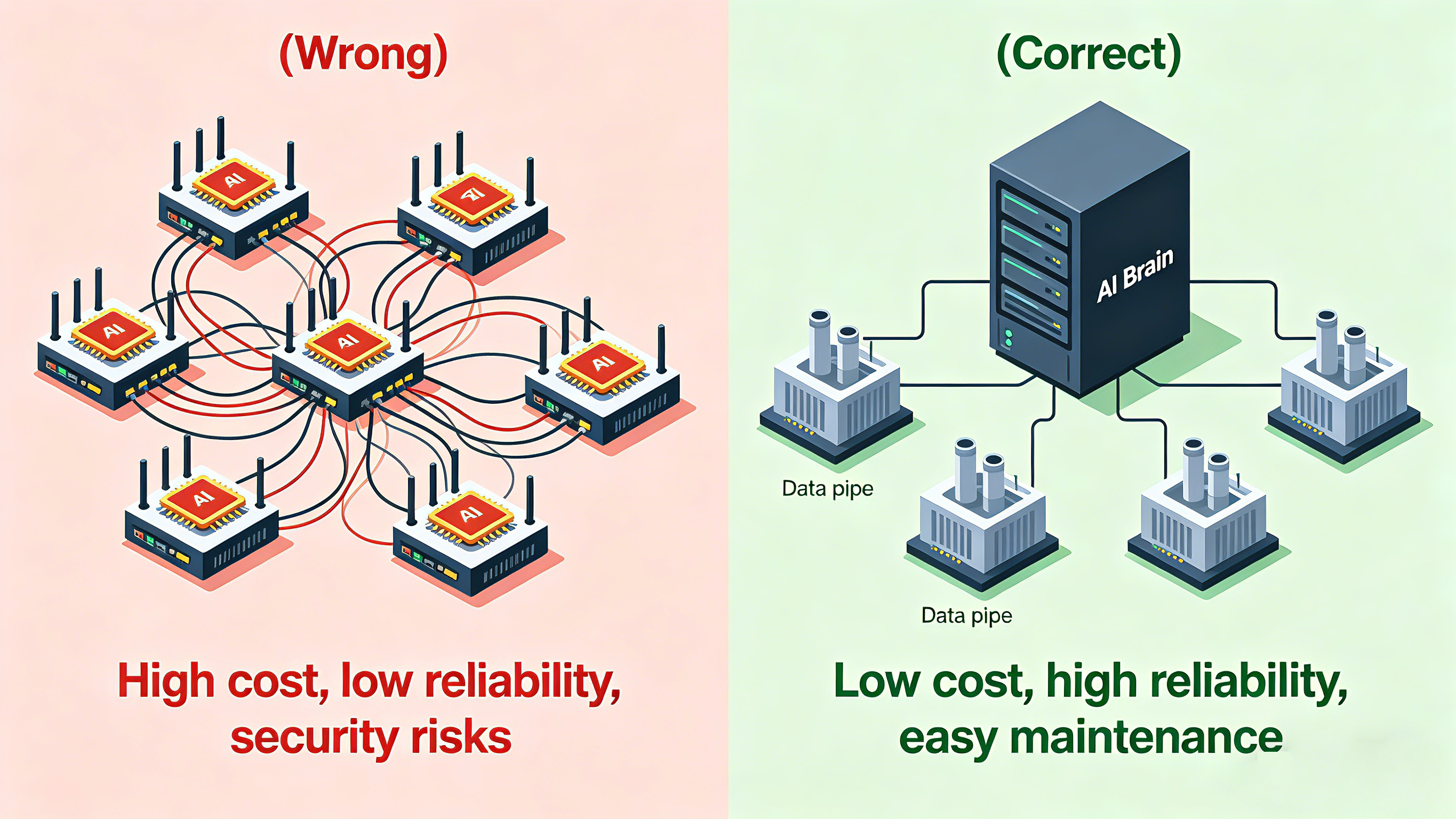
4. The absolute advantage of centralized AI: where the real brain belongs
A sound industrial architecture
Cloud / edge computing nodes – Aggregate all data, run large models, perform global optimization, predictive maintenance, and scheduling decisions. This is the brain.
Industrial routers – Reliably collect and upload data, and cleanly execute commands from the center. This is the nerve.
End‑of‑line PLCs / actuators – Quickly execute local closed‑loop control. This is the local reflex (no brain needed).
Advantages of a central AI
Global data → better decisions.
Unlimited compute → true large models.
Easy maintenance → one update, global effect.
Auditability and compliance → every decision traceable.
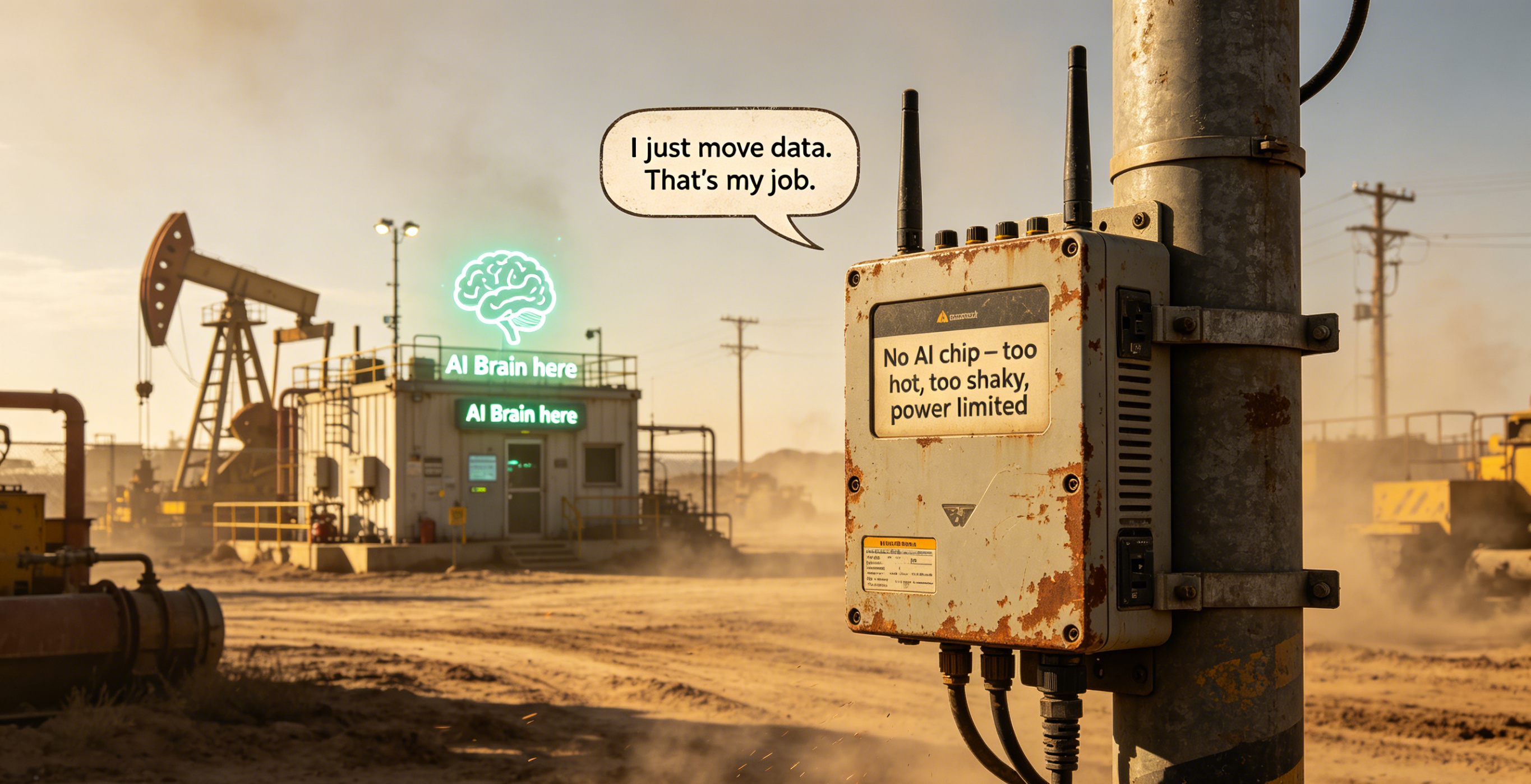
5. The correct evolution of industrial routers: don’t be a brain, be the strongest nerve
Reject pseudo‑intelligence; deepen core competencies
- Higher reliability – Dual power supplies, hardware watchdog, surge protection.
- Stronger security – Deep packet inspection (no AI needed), hardware encryption engine, zero‑trust architecture support.
- More flexible connectivity – 5G/4G, Wi‑Fi 6, TSN (Time‑Sensitive Networking).
Limited, practical “light intelligence” – This is not an absolute rejection of any intelligence, but a rejection of large models on the end side. Simple deterministic rule engines (e.g., “switch link if traffic exceeds threshold”) are fine – they are logic, not AI.
- Clear boundary – Routers can do data preprocessing (deduplication, compression, timestamping) but never make independent decisions.
6. Concfusion: Back to common sense – each part plays its role
Restate the analogy – The human body’s most efficient design is one smart brain connected to reliable nerves and nimble fingers. It does **not** put an extra brain on every fingertip.
A warning to the industry – Be wary of vendors who market “AI‑powered routers” just for hype. That path only adds complexity, reduces reliability, and inflates costs.
Final recommendation – Let AI large models do their powerful work in the cloud or central nodes. Let industrial routers return to their essence: stable, secure, transparent pipes. **The best intelligence is architectural intelligence – not blind, local fashion‑following.**

